
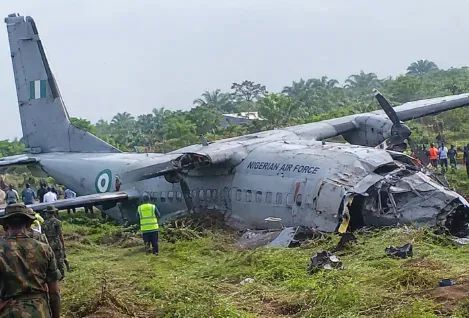
The Nigerian Air Force has confirmed the crash of an ATR-42 aircraft in the Igbokoda area of Ondo State, adding another incident to Nigeria’s long and often painful history of military aviation accidents.
According to the information released by the Nigerian Air Force, the aircraft was conducting a routine mission from Benin to Lagos when it crashed around Igbokoda in Ondo State. The ATR-42 is a twin-engine turboprop aircraft used by the Nigerian Air Force for surveillance, transport and other specialised missions.
The circumstances surrounding the crash, including the precise cause, remain subject to investigation. Aviation authorities and the Nigerian Air Force are expected to examine the aircraft’s technical condition, weather conditions, flight data, crew actions and other operational factors before reaching a definitive conclusion.
It is important, therefore, to distinguish between what has been officially confirmed and information circulating from unofficial sources. Until the investigation is completed, speculation about mechanical failure, pilot error, weather or any other specific cause should not be presented as established fact.
Nigeria’s Troubled History of Military Air Crashes
The Ondo accident is not an isolated event. Over the decades, the Nigerian military has experienced a number of serious aircraft accidents involving fighter jets, transport aircraft, helicopters and training aircraft. Some have occurred during combat or operational missions, while others happened during routine flights, training exercises or transportation duties.
The 1992 Nigerian Air Force C-130 Disaster
One of the most devastating military aviation disasters in Nigeria occurred on 26 September 1992, when a Nigerian Air Force C-130H Hercules crashed shortly after take-off from Lagos.
The aircraft was carrying military personnel and their families and was reportedly unable to gain sufficient altitude after take-off before plunging into a canal near Lagos.
The crash killed all 163 people on board, making it one of the deadliest aviation disasters in Nigerian history and the deadliest known accident involving the Nigerian Air Force.
The disaster remains a major reference point in discussions about Nigerian military aviation safety because of the enormous loss of personnel associated with a single flight.
The 2006 NAF Dornier 228 Crash
Another significant tragedy occurred in 2006, when a Nigerian Air Force Dornier 228 aircraft crashed during a military flight in Kaduna State.
The aircraft was involved in a military mission when it went down, killing members of the crew and passengers aboard. The accident again raised questions about aircraft maintenance, operational safety and the challenges associated with maintaining an effective military aviation fleet.
The 2011 Nigerian Air Force Crash
Military aviation suffered another fatal accident in 2011, involving a Nigerian Air Force aircraft in the northern part of the country. The incident resulted in fatalities among military personnel and became part of a succession of accidents that periodically affected the Air Force’s operational fleet.
Such accidents have historically occurred across several aircraft types, demonstrating that the problem cannot simply be attributed to one particular aircraft model.
The 2015 Yola Air Force Crash
On 11 February 2015, a Nigerian Air Force Dornier 228 aircraft crashed near Yola in Adamawa State while returning from a military operation.
The aircraft was reportedly carrying military personnel and supplies. Several people were killed, while others survived the crash.
The accident occurred during a period when Nigerian forces were heavily engaged in operations against Boko Haram in northeastern Nigeria, meaning that military aircraft were operating under considerable operational pressure.
The 2021 Abuja Beechcraft King Air Crash
One of the most prominent recent Nigerian military aviation disasters occurred on 21 May 2021, when a Nigerian Air Force Beechcraft King Air 350i crashed shortly after take-off from Abuja.
The aircraft was carrying senior military personnel, including the then Chief of Army Staff, Lieutenant General Ibrahim Attahiru. All 11 people aboard were killed.
The crash generated widespread national mourning because General Attahiru had been appointed Army Chief only months earlier and was leading the Nigerian Army during the country’s intense security challenges.
The 2021 Alpha Jet Crash
Later in 2021, a Nigerian Air Force Alpha Jet went missing during an operational mission in the northwestern part of the country.
The aircraft had been deployed as part of Nigeria’s military campaign against armed groups. Its loss demonstrated another dimension of military aviation risk: aircraft operating in hostile environments may face dangers that do not exist during ordinary training or transportation flights.
Military Helicopter Accidents
Nigeria’s military aviation history also includes several serious helicopter accidents. Nigerian Air Force helicopters, as well as aircraft operated by other security agencies, have been involved in crashes during operational deployments, training and transportation.
One particularly significant incident occurred in 2023, when a Nigerian Air Force MI-171 helicopter crashed in Niger State while conducting an operational mission. Several people aboard were killed.
The MI-171 incident illustrated the difficult conditions under which military aviation personnel frequently operate, particularly when aircraft are deployed over remote areas for security operations, casualty evacuation, surveillance and troop support.
Why Military Aircraft Crashes Are Particularly Serious
Military aviation presents challenges that are considerably different from commercial aviation. A military aircraft may be required to operate at low altitude, in difficult weather, over remote terrain or during missions involving significant operational pressure.
Aircraft may also accumulate substantial flight hours, while military operations can require ageing platforms to remain in service because replacing sophisticated aircraft is extremely expensive and time-consuming.
For Nigeria, these challenges are compounded by the country’s extensive security commitments. The Nigerian Air Force has simultaneously been involved in counter-insurgency operations in the Northeast, counter-banditry operations in the Northwest and North Central regions, maritime surveillance, intelligence gathering, transportation and other national security assignments.
This means that the Air Force’s aircraft are not merely ceremonial assets. They are constantly being called upon to perform demanding missions across a geographically large country.
The Ondo Crash Raises Fresh Questions
The crash at Igbokoda will inevitably renew questions about the safety and maintenance of Nigeria’s military aviation fleet.
The ATR-42 involved was reportedly flying a routine mission between Benin and Lagos, rather than conducting a combat operation. That makes the investigation particularly important because the circumstances surrounding a routine flight can provide valuable information about aircraft condition, maintenance procedures, crew readiness and operational protocols.
The appropriate response at this stage, however, is neither to speculate nor to assign blame. The priority should be search and rescue, recovery, identification of those involved, preservation of evidence and a transparent technical investigation.
Military aviation accidents are tragedies, but they can also expose weaknesses that, if properly addressed, may prevent future loss of life.
A Pattern That Deserves Attention
Viewed individually, each military aircraft accident has its own circumstances. Viewed collectively, however, the repeated crashes raise a broader question about the sustainability of Nigeria’s military aviation infrastructure.
Aircraft require regular inspection, specialised spare parts, highly trained maintenance personnel, simulator training, adequate flight hours and continuous investment. A military aviation system cannot remain safe simply because pilots are highly skilled; safety depends upon the entire ecosystem supporting the aircraft.
The history of Nigerian military aviation therefore demonstrates both the courage of the men and women who operate these machines and the risks they accept in the service of the nation.
As investigators begin examining the Ondo crash, Nigerians will understandably want answers. What caused the ATR-42 to go down? Was there a mechanical problem? Were weather conditions a factor? Was there an operational issue? Were there warning signs before the flight?
Those questions can only be answered responsibly through a professional investigation.
For now, the Igbokoda crash should be remembered first as a human tragedy and as a solemn reminder that behind every military aircraft is a crew whose mission may take them into circumstances most Nigerians will never see.
Note: The historical record above is deliberately selective rather than an exhaustive list of every Nigerian military aircraft accident. For the Ondo incident, casualty figures and the cause of the crash should be updated only from official NAF, aviation-investigation or other authoritative releases as the investigation develops.