
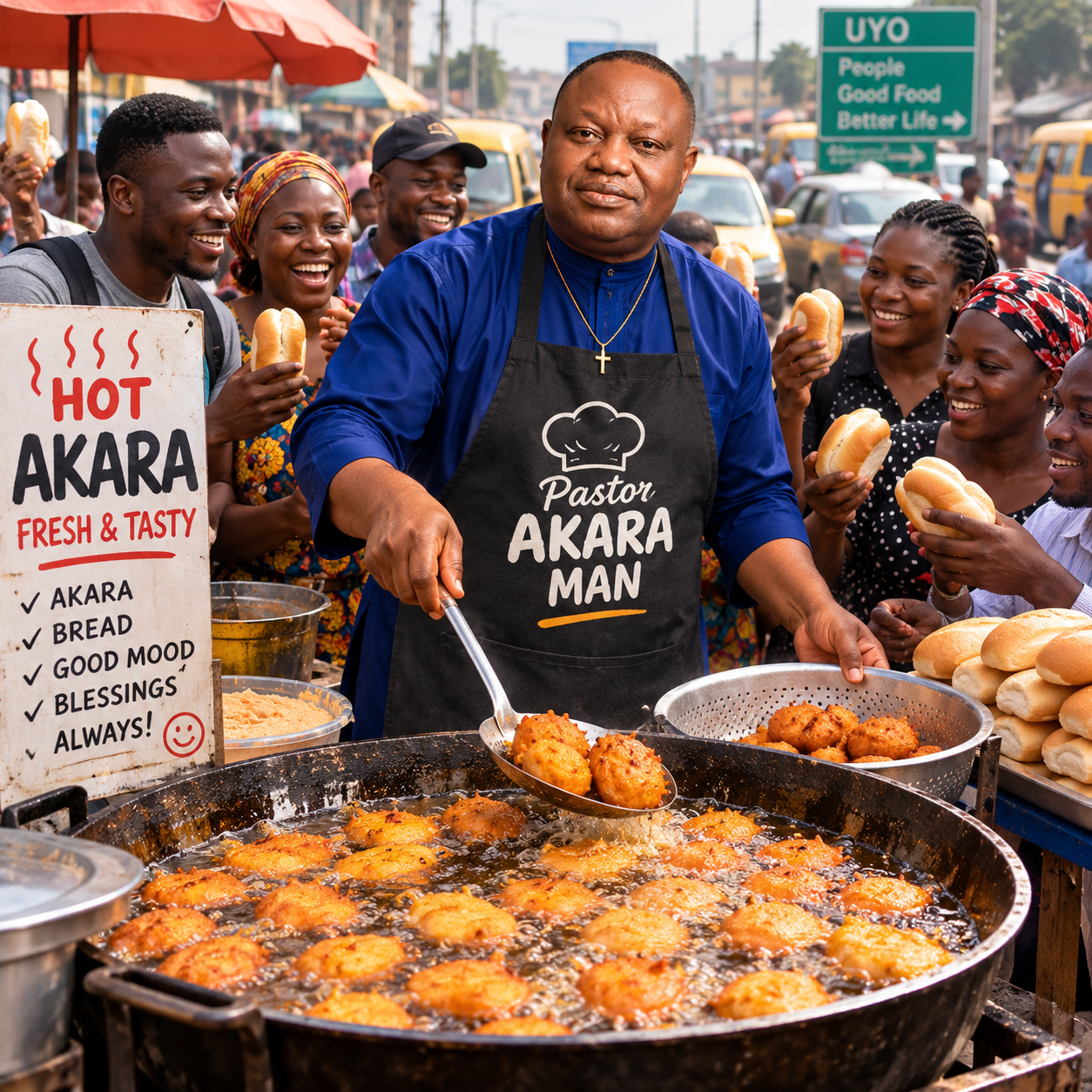
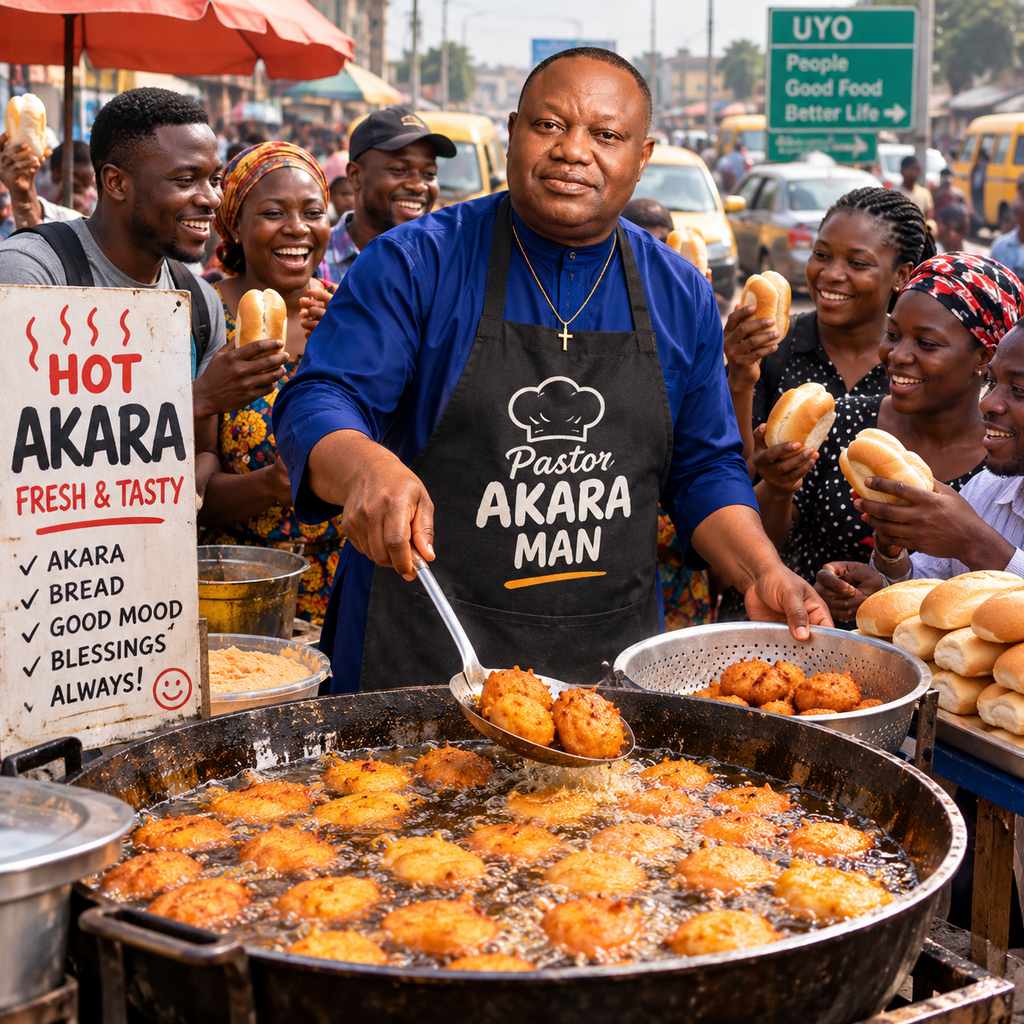
Welcome, ladies and gentlemen, to the African Leadership School of Advanced Motivation, where the people are poor but the speeches are rich. Today’s masterclass is titled: “How to Become a Millionaire Without Asking Difficult Questions About Government.” Our distinguished speaker arrives in a convoy long enough to qualify as a minor highway project, steps onto the podium and announces, “My dear people, never despise small beginnings. Start with Akara and bread!” The crowd applauds politely while the woman who has sold Akara for fifteen years looks at her frying pan and wonders why nobody told her that she had been sitting on an ₦10 million goldmine.
Pastor Umo Eno’s recent Akara-and-bread example, particularly the suggestion that such a venture could be used to illustrate a path toward ₦10 million, created exactly the kind of social-media storm that happens when motivational mathematics meets Nigerian mathematics. Nigerian mathematics is a special discipline in which ₦10 million sounds enormous until you subtract beans, vegetable oil, bread, gas, transportation, rent, school fees, electricity, food and the mysterious ₦500 that somehow disappears every time you leave the house.
And then came the déjà vu. Nigerians remembered the earlier advice associated with First Lady Oluremi Tinubu about poor people considering businesses such as Akara and buns. Suddenly, the nation appeared to have discovered a revolutionary economic policy: if you are poor, fry something. If you are still poor, fry more. If you remain poor after frying all day, perhaps you have not fried with sufficient determination.
Imagine the African motivational conference of the future. The unemployed graduate approaches the microphone and says, “Your Excellency, I have a degree, no job and ₦2,000.” The leader responds, “Excellent! Buy beans.” The graduate says, “But sir, beans are expensive.” “Buy less beans.” “Oil is expensive.” “Use less oil.” “Fuel is expensive.” “Use firewood.” “There is no money.” “Think positively.” The graduate finally asks, “Sir, what about your own business?” The hall suddenly experiences a miraculous power outage.
Then the ghost of the famous “I had no shoes” story enters the room. Goodluck Jonathan’s account of his humble beginnings was intended as encouragement: look at where I started; your circumstances do not have to define your future. But Nigerian audiences, being professionally experienced in detecting irony, heard another message: I once had no shoes, and now I am president. The poor man listening perhaps wondered whether the missing chapter was titled “How the Shoes Eventually Arrived.”
This is the danger of inspirational autobiography when delivered from the summit of political power. “I was once poor” sounds inspiring when you are speaking to poor people, but the audience is likely to ask the inconvenient sequel: “What did you do after becoming powerful to make sure fewer people remained poor?”
African politics has produced an entire library of these motivational classics. When jobs disappear, leaders encourage entrepreneurship. When electricity disappears, they encourage innovation. When food becomes expensive, they encourage farming. When young people cannot find work, they are told to acquire skills. At this rate, the next national economic plan may simply be a WhatsApp message saying: “Guys, be productive.”
Somewhere in Kenya, Nigeria, Ghana, South Africa or elsewhere on the continent, another leader is preparing the next masterpiece: “Our young people must stop looking for white-collar jobs and become creators of wealth.” Wonderful. But there is one small detail. The young creator would like electricity, affordable credit, reliable roads, internet access, security and a market. Apparently those are advanced-level entrepreneurship skills.
Political leaders also love telling citizens to “tighten their belts.” African citizens have tightened their belts for so long that the belts have begun asking for constitutional rights. Meanwhile, the ordinary family is reducing meals, the student is managing transport money and the small trader is calculating whether raising the price by ₦100 will drive away customers. The government then announces that everyone must sacrifice for the future. The citizen looks around and asks, “Who exactly is sacrificing, and who is attending the banquet?”
Of course, we must be fair: Akara is a serious business. A well-run food business can generate income, employ people and grow into something substantial. The satire is not against the woman frying Akara at the roadside; indeed, she may possess more entrepreneurial courage than half the people giving speeches about entrepreneurship. The satire is against pretending that individual hustle can replace sound economic policy.
Because there is a world of difference between saying, “Start an Akara business,” and saying, “Here is ₦500,000 in affordable financing, here is a clean market stall, here is reliable electricity or subsidised cooking energy, here is business training, here is access to customers, here is security, and here is a government determined to make your business environment work.” The first is a speech. The second is governance.
Imagine if politicians were required to demonstrate their motivational advice personally. If the message is “Sell Akara,” tomorrow morning the governor arrives at 5:30 a.m., buys his own beans, soaks them, grinds them, buys oil at market price, lights the stove, fries until noon and personally accounts for every naira. If he makes ₦10 million after expenses, we shall respectfully rename the Ministry of Finance Ministry of Akara Economics.
And if the experiment fails, perhaps we will finally understand the lesson. The poor do not necessarily lack motivation. They lack margins. They lack purchasing power. They lack affordable capital. They lack predictable infrastructure. They lack economic stability. Telling somebody drowning to “develop swimming skills” is not entirely useless, but throwing them a rope would demonstrate considerably better leadership.
African leaders therefore need a new motivational vocabulary. Instead of saying, “Why don’t you start a small business?” say, “How can government remove the obstacles preventing your small business from becoming a large one?” Instead of saying, “I also suffered,” say, “Because I suffered, I will ensure that the next generation does not have to suffer in exactly the same way.” And instead of telling citizens that prosperity begins with Akara, perhaps tell them that prosperity begins with good economics, competent governance and an environment where honest work is rewarded.
Until that day, the African motivational seminar continues. The microphone is polished, the cameras are rolling, the convoy is waiting outside and the speaker raises one hand dramatically: “My people, never give up! Start with Akara and bread. You can make ten million naira!” The crowd erupts. The Akara seller quietly counts today’s profit. The unemployed graduate checks his bank balance. The mother calculates tomorrow’s food. And somewhere behind the stage, an aide whispers, “Your Excellency, the people are asking whether the ₦10 million includes the cost of the beans.” The motivational speaker pauses. For the first time in the history of African political inspiration, somebody has asked for the full business plan.